
Gord McKenna
Geotechnical Engineer, Landform Designer
Gord McKenna is a geotechnical engineer and geologist with 32 years of experience in mine operations and consulting for oil sands, coal, and metal mines. Gord founded McKenna Geotechnical Inc in 2017 to bring his landform design experience to a broader audience and provide independent geotechnical advice to geotechnical review boards, panels, and First Nations. Gord and his team have designed 20 reclaimed watersheds that cover 40 square kilometres and incorporate 30 wetlands and 90 kilometres of streams. He has been a lead contributor to several manuals on landform design, mine reclamation, and tailings, and co-authored 100 papers and book chapters. He has a bachelor’s degree in geological engineering from the University of British Columbia and a PhD in geotechnical engineering from the University of Alberta. Gord is also an adjunct professor at the U of A.
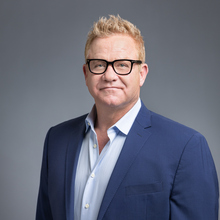
Mike O'Kane
Senior Technical Advisor
Mike O’Kane founded Okane Consultants in 1996, a company providing integrated mine planning, closure, and relinquishment solutions to the mining industry internationally. Mike is the chair of Okane’s Board of Directors and continues to work within Okane as a senior technical advisor, using his wide-ranging technical expertise and knowledge on risk management best practices as tools for development and communication of closure planning and project specific objectives and designs. Mike is a recognized subject matter expert in cover system and landform design, and application of unsaturated zone hydrology and geochemistry, for mine waste management. He provides subject matter expert reviews for numerous government and private agencies while also being a member of multiple advisory panels. Mike holds a Global ESG Competent Boards Designation. In 2014, Mike received the University of Saskatchewan Alumni Achievement Award for “Global Development of his Business and Corporation, and Philanthropy.”
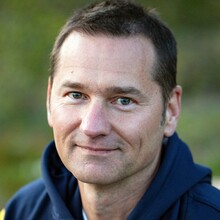
Justin Straker
Soil Scientist and Forest Ecologist
Justin Straker is a soil scientist and forest ecologist with the Integral Ecology Group. Currently, he regards himself principally as an inter-disciplinary reclamation designer. Justin has 30 years of experience in applied terrestrial ecology, with a primary focus on ecological aspects of mine reclamation and closure. He has focused extensively on reclamation/closure design, implementation, research, assessment, review, and guidance projects, and brings to his work experience in hard-rock, soft-rock, and oil-sands surface mines. Justin works primarily in northern North America but has also applied his skills in Alaska, South America, and South Asia. Much of Justin’s attention is directed at identifying areas where industry is underperforming in its reclamation objectives and determining solutions in the uncertain environment of ever-shifting policy priorities. Justin has a bachelor’s degree in anthropology from McGill University, and a master’s degree in soil science from the University of British Columbia.

Kathleen Hanley
Geotechnical Engineer
Kathleen Hanley is a geotechnical engineer who takes a multidisciplinary and systems-oriented approach to mining projects. She has more than 15 years of design experience on tailings and water management and mine closure projects. Kathleen has worked in the development, construction, operations, and closure stages of mining projects throughout the Americas. She has held leadership and management roles that have honed her scope development, project implementation, and communication expertise. Kathleen is skilled at working with teams to develop a systemic understanding of a problem and potential solutions.

Haley Schafer
Geotechnical Engineer
Haley is a geotechnical engineer with an MSc and PhD from the University of Alberta. Her PhD research focused on the development of risk management tools to aid in assessing and managing the long-term risks associated with tailings dam closure. Haley currently works as a geotechnical engineer at BGC Engineering designing tailings storage facilities.

Stella Swanson
Aquatic Biologist, Risk Assessor
Stella received her BSc (Hons) from the University of Regina and her PhD in Limnology from the University of Saskatchewan.
Stella has spent the past 45 years assessing the impacts of a wide range of human activities on the landscape and then working with multidisciplinary teams on mitigation of those impacts. Her work on review groups and advisory panels has helped her understand the importance of engagement with communities. This understanding has produced a focus on public and Indigenous engagement in all her work.
Stella is currently a member of the International Joint Commission’s Elk-Kootenai/y Study Board which is tasked with exploring the impacts of water pollution in the transboundary Kootenai/y watershed. The Study Board is comprised of Western Science and Indigenous experts and knowledge holders.

Aileen Cash
Geological Engineer
Aileen Cash is a geological engineer specializing in closure design for tailings and waste rock landforms, including facilitation of multidisciplinary closure teams, design and construction of cover trials, and hydrogeological and geotechnical site-characterization investigations. Her research focuses on the study of historical mine waste rock, including evaluation of unsaturated and geotechnical material properties to assess their effect on hydraulic flow.
She is a senior engineer at BGC Engineering and has been involved developing progressive reclamation techniques for mines in Central Canada. She has a bachelor’s degree in geological engineering from the University of Waterloo and a master’s in geoenvironmental engineering from the University of Alberta.
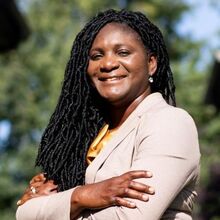
Monica Ansah-Sam
Principal Geotechnical Engineer
Monica has twenty-five years of combined engineering experience in mining geotechnique, dam safety, tailings and mine waste management, closure and landform design and field operations. With twenty years in key technical leadership roles such as Engineer of Record, Tailings and Closure Lead, Senior Geotechnical Engineer, Senior Tailings Advisor, Project Technical lead, Operations Support lead in Consulting, oil and gas industries in Alberta.
Monica served as General Manager, Tailings and Dams in Hard Rock Mining in Ontario, Manitoba and Newfoundland Labrador. And recently Global Geotechnical Governance Manager for Vale’s Base Metals operations in Brazil, Indonesia and Canada prior to becoming an independent consultant.
Monica has an MESc, from Western University and an MBA from University of Calgary. Monica has written numerous papers on closure and is currently an independent consultant/ technical reviewer for mine sites internationally.

Jerry Vandenberg
Environmental Chemist
Jerry is an environmental chemist who is passionate about advancing the knowledge and state of practice of pit lake management. He has 25 years of consulting experience related to environmental assessment of mines, operational mine water management, and mine closure, focusing on copper, diamond, oil sands and uranium mines in Western Canada. He holds a B.Sc. in Environmental Science and M.Sc. in Environmental Chemistry, both from the University of Calgary.

Christine Daly
Associate Director
Christine Daly is an award-winning reclamation, sustainability, and community engagement specialist. She is the Associate Director of Institutional Commitments at the University of Calgary, where she is leading local campus engagement on advancing the Institutional Sustainability Strategy Action Plan (2025-2028) and national engagement on the 17 United Nations Sustainable Development Goals (SDGs) as a Co-Chair for SDG Engagement at the Canadian hub of the UN Sustainability Development Solutions Network (SDSN Canada). In 2025, she was the Conference Chair for the 7th Annual Together | Ensemble, Canada’s premier conference for the SDGs, and served as an official delegate representing Canada at the United Nations High-Level Political Forum on Sustainable Development.
Christine has two decades of experience leading innovation and system change in the oil sands mine closure reclamation, including fen reclamation and reclamation of Pond 1 (now known as Wapisiw Lookout). During her PhD, Christine co-created a participatory and inclusive approach to mine reclamation and closure planning with Fort McKay First Nation co-researchers, called “co-reclamation.” Together, they developed intercultural planning tools and explored co-reclamation of the Fort McKay Traditional Territory in Treaty 8, northeastern Alberta, Canada, which is affected by oil sands activities. Christine continued to advance collaborative reclamation approaches with local communities as a Postdoctoral Associate at the University of Waterloo and now, as a Board Member of the Landform Design Institute.

Natalie Melaschenko
Ecologist
Natalie Melaschenko has been working as an ecologist since 2002. For the past thirteen years she has worked in the mining industry in terrestrial reclamation monitoring, research, and closure planning at a variety of mines in British Columbia, Yukon, Saskatchewan and Ontario. Her current focus is facilitating collaboration between Indigenous Nations and mines, including multi-disciplinary teams, to co-plan for closure of mine sites. Natalie works to carry out closure planning that is approached in a respectful way, supporting reclamation that is successful, as agreed upon by all parties, and meaningful over the long term. Natalie has a B.Sc. from Queen’s University and a M.Sc. from the University of British Columbia. She is the president of Integral Ecology Group.

Dënë Cheecham-Uhrich
Dënë chu nih hhel alasna [Social Scientist]
Dënë Cheecham-Uhrich is a proud member of the Dënësułinë Treaty 8 Territory Clearwater River Dënë Nation. She leads innovative and intrinsic research related to water, land, and human health in her community and Indigenous communities across Northern Saskatchewan. She works toward creating a new generation of regenerative visionaries and re-establishing Indigenous communities as equal treaty, inherent and local partners in Turtle Island. Dënë works with her growing research relatives to co-create community driven protocol. She is passionate in strengthening relationships and partnerships that support Indigenous and interdisciplinary science to be more transformative in developing community led solutions by reimagining how we engage diverse knowledge systems with Indigenous communities and researchers from all disciplines. She lives in constant flux with learning to honour, respect and give gratitude to her ancestors, mentors and kinships.

Casey Cawston
Elder
Casey Cawston is a member of the Lower Similkameen Indian Band (LSIB). His parents, Dick Cawston and Nancy Marsel, showed him the way of nature as a child and he spent much of his youth on the back of a horse, herding cattle for local ranchers and guiding and packing in his local mountains. Casey has spent 40 years in the mining and logging industries working throughout British Columbia. He currently works for the LSIB Natural Resources Department, continuing to work with the mining industry, as an advocate for his community.

Stephen Day
Geochemist
Stephen Day, MSc, PGeo is a Corporate Consultant at SRK Consulting based in Vancouver, BC. His academic background was in hard rock geology at UBC with an emphasis on geochemical exploration. Following early work with the province of BC researching stream sediment geochemistry for exploration, he has worked as a consultant in the mining industry since 1989 focussing on mine waste geochemistry, water quality modelling and conceptually waste management planning. His experience includes new mine developments, operational optimization and closure planning with experience in the Americas and Asia. He currently serves on several Independent Tailings Review Boards (ITRBs).

Brent Mooder
Hydrogeological Engineer
Brent Mooder, M.Sc., P.Eng., is a hydrogeological engineer with over 27 years of applied earth sciences consulting experience in the mining industry. He supports projects at every stage, from pre-feasibility, through operations and progressive reclamation, to post-closure and rehabilitation. Brent’s expertise in mine hydrogeology spans sub-landform to regional scales, and he is dedicated to integrating closure considerations throughout mine planning, design, and development.

Jean L'Hommecourt
Elder
Jean is Dënesułiné and her traditional and cultural way of life on the land from upbringing remains instilled within her spirit. Being on the land has helped her retain the Dene language and continues to give me her identity, despite the separation of her childhood and her family. Jean is currently employed with the Fort McKay First Nation Sustainability Department as a Traditional Land Use Specialist. She serves as the Co-Chair for the Indigenous Knowledge Committee for the Ronald Lake Buffalo (RLB) Co-operative Management Board for our region, working towards a recovery strategy ensuring the RLB herd remains disease free and sustainable for future generations to come. She is also a member of the Circle of Advisors on a Landform Design Institute project called a Global Review of Indigenous Community Collaboration in Mine Closure. She was the community liaison on the Co-Reclamation Project and a board member of the Keepers of the Water Group.

